This one’s not going under the standard CC license that I normally use. I’d like to keep this one in reserve because it may turn out to be a viable thing at some point, so, no sharing, transforming, using for commercial or non-commercial purposes, etcetera, without my explicit permission. Contact me at the email on the bottom of this page if you want my permission or something to that effect.
Agency developed out of a couple of disparate ideas that ended up coming together to make a neat little card game that I actually managed to make a prototype for and playtest a little bit. To explain the motivations for its creation, I first have to talk about its history.
For a while, I had an idea for a game with some sort of elemental scissors-paper-rock game as a foundation – not as anything serious, just as a passing idea. While it was not directly inspired by Pokémon, I will admit that it was probably influenced by it. And, to top it off, it didn’t just have the standard things like “Water beats Fire” or “Lightning beats Metal”, it also included the ability to combine two elements to make another one – “Fire and Earth combine to make Metal” is a good example. The problem was that it was complex and somewhat clunky – not all of the element interactions made intuitive sense, even after a long time playing around with the permutations of the elements (one of which was a placeholder “Psychic” element), and after adding an extra scissors-paper-rock set to include things like Demon and Wizard… it got complicated quickly.
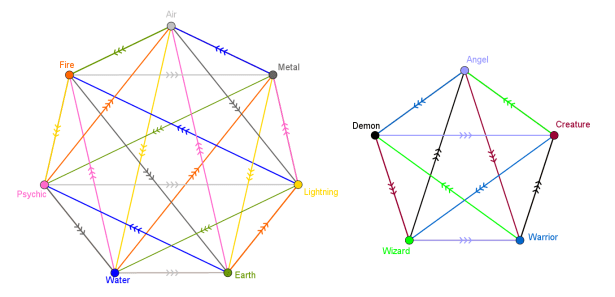
Pictured: quality game design.
After that, this sort of idea lay dormant for a while, until another thought came along a few years later – the twin problems of first move advantage and RNG in games. Chess, for example, has a first move advantage problem (not a huge amount, but it’s there), as well as zero random elements, which means that many games follow the same pattern, at least to start with, as well as it being at least theoretically solvable. I enjoy chess a great amount, and I would argue that these are positive qualities of chess (the zero RNG, at least), but I was wondering if it were possible to both remove first move advantage, while introducing a small but manageable amount of luck to make games more variable, as well as preserving the game as a skill-based one. It was around the same time I was pondering this when I stumbled upon Wu Xing, the Chinese five elements system that instantly reminded me of my abortive attempts to make my own element system work nicely. And thus, after combining the ideas and including some small original elements, Agency was born.
Agency is a two-player game. You are playing as a god against another god, and to settle disputes between each other, you use your proxies in the corporeal planes against each other – these are your agents. After the game is set up, there is no luck – winning is up to you. Both players are given four Decision cards, one with each suit from a deck of cards, and there is another set of four Decision cards in front of you. You are each given a deck of 25 custom cards, each with an element and a type of agent on it – one for each combination. Each element and each agent beats two others.
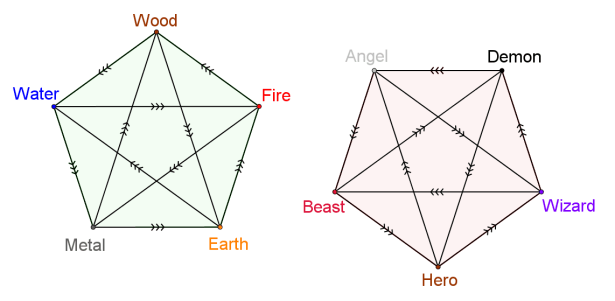
Both decks of cards are shuffled, and the first four cards from each deck are placed in front of the central four Decision cards, like the example below:
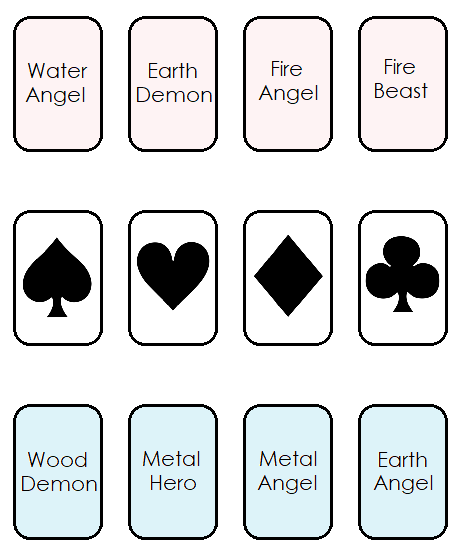
Each player then secretly chooses one of their own Decision cards to put face-down next to their respective deck cards. Once both players have chosen a Decision card and played it face-down, they simultaneously reveal their card. To win a round, your card must beat their card in either Element or Agent. The first round is always Agent, so if Red chooses their Club card, Fire Beast, and if Blue chooses their Diamond card, Metal Angel, then Red wins that round. If there is a draw, then look at either Element or Agent, depending on what was not used in that round. If, in the first round, both players choose their Diamond card, then there is a tie for Agent, and to tiebreak, both players resort to the Element, and so Red’s Fire beats Blue’s Metal. If there is still a tie, then the cards are removed from the game and play continues.
Once a round has been won, the chosen deck cards are removed from the game, and the winner gets a point. Both players retrieve their Decision cards, shuffle their hands, and replace the used card with the top card from their deck. The losing player chooses whether to use Element or Agent for this round.
This is the basic game loop of Agency. How to win is something I’m not sure about – first to a certain amount could be how to win, like first to 10, or perhaps winning 5 games in a row, or something to that effect. The game loop is something I’m pretty happy with though. I’ve playtested this a little bit and it’s surprisingly fun – like scissors-paper-rock, but with a skill element in trying to out-think the other person. It’s surprisingly fun. If you would like to make a mock-up of the game and play with your friends, then be my guest, as long as you credit me for its creation, and don’t use it commercially, etcetera etcetera. Enjoy!
 bayd.ren