Here in my tiny little corner of the internet, I once wrote about what it was like living with depression (bad, in case you’re curious). Now I have emerged from the other side, so I would like to tempt fate by talking about what life is like after depression.
What was depression like?
Depression is one of those things that I understood on an intellectual level beforehand – all the happiness gone from the world, nothing matters anymore. I’d read Hyperbole and a Half’s comics about depression, I had an absolute obsession with Harry Potter as a child and read about the description of Dementors, part of my job involved helping people with depression, to the extent that I self-diagnosed initially with material I’d gotten at a conference designed to help people with mental illness. There’s this philosophical idea called Mary’s Room, where Mary is a scientist who knows everything there is to know about colour, even though she’s lived her entire life in a black-and-white room. Then at one point, the door opens and she’s allowed to go see the rest of the world. Did she learn anything? My personal answer to this is that if she does learn something, then she clearly didn’t know everything about colour beforehand. And hoo boy, did I learn something when I opened the depression door.
Depression was fucking terrible. I try to make it a point in these posts not to resort to profanity – I’m trying to be somewhat formal here – but I don’t think I can really emphasise how bad it was without a bit of a linguistic slap in the face. It was really fucking bad.
Let’s start by talking physically, because yes, depression can have physical symptoms, and they’re often easier to see. ‘Low energy’ is one, but those are just words. To me, low energy was having a bath instead of laying in bed because at least I moved. Low energy was not cooking in months because why bother. Low energy was being tired every single day, but not wanting to sleep because that involved closing my eyes and being alone with my thoughts. Low energy was being in the process of buying a cane just to feel better about being able to walk around my house.
And every thought was bad. Part of it was going ‘maybe I don’t actually have depression, maybe I’m just faking it so people will care about me’, even though if you’re buying a cane just for being alone in your house, maybe something is actually wrong. Rationally, I knew things were bad. But you can’t logic yourself out of a position you didn’t logic yourself into, and I wasn’t depressed because I wanted more attention (side note: there is a weird push-pull in depression of ‘I want people to care about me and help me, but also I don’t deserve it, but also I need it, but also I don’t want them to see me like this’. Depression is fractally horrible.).
Depression is when your whole being turns against you. Depression is when everything that kept you going ceases to be worth it. Depression is when every thought is about how bad life is, and also, how nothing matters anymore. Depression is when every positive thought is something logical that you have to figure out rather than feel. It feels like a design flaw in the human experience – suddenly the full power of your brain is now redirected in order to make you feel like life isn’t worth living anymore. Why should this even be possible? It’s like you designed a lightbulb that just occasionally removed all light from the surroundings instead.
I can’t give you a metaphor to explain depression because depression is void of meaning – it lives in the hole where metaphors die. If you haven’t lived through depression, I can’t explain it sufficiently to you, and if you have, you probably know far too well what it’s like.
What kept you going?
Momentum, pretty much. I still had a job with responsibilities. I still needed to eat. I still had a routine I could keep going with. The grooves of my life were worn sufficiently enough for me to keep following them.
I had support – family and friends and colleagues. People who could take me alienating them and messing with our relationship and go ‘he’s not himself, he needs help’.
Work helped. My boss had had experience with mental health issues before and managed to walk the line between ‘you need to do this’ and ‘I know this is all you can do right now’. If someone pushes you, you might as well move (and I mean this in the best way possible – I didn’t really have the mental energy to push myself).
I’d made a commitment years prior that if I was ever depressed, I wouldn’t self-harm or commit suicide. So when I was depressed, I never did either one of those (pretty obviously for the latter, or it would be very impressive to have written this). I understood it though, as kind of a ‘oh now I get it’. My way of feeling something was putting on comedy shows – depression killed my happiness but it didn’t kill my sense of humour, which felt very strange.
What started your depression? And what ended it?
All it takes is a bunch of bad habits chained together and then kickstarted. It’s kind of like the Chernobyl disaster – it was designed terribly and then everything went wrong. To stop being depressed, I needed to find those habits, fix those habits, and reverse whatever weird chemical brouhaha was happening inside me. So here’s the process, or at least my process:
1. Realise you’re depressed. This may be harder than it looks. I recommend knowing as much about being depressed as possible beforehand, so you can tentatively self-diagnose (THIS IS NOT THE ONLY STEP). Alternatively, have a trusted person let you know, and then since you trust them, believe them.
2. Go and get therapy. If you knew all your bad habits and how to fix them, you probably wouldn’t be in this situation, so go find a professional to help. This is one of those ‘if you have time/money’ steps, unfortunately, but if you have some spare, now is an excellent time to use them. You may need to go through many professionals for help – the second psychologist I spoke to was excellent for me. This is despite, or possibly because, their process involved weird pseudoscientific spiritual mysticism stuff. I am very much not into that, but quite frankly, my rational side was not helping, and I could use some different metaphors. It also helped that my psych was extremely perceptive and picked up on multiple bad habits of mine within 10 minutes of me being there. What I’m saying is, go in with an open mind.
3. If this does not work, and it may not be sufficient, and you end up crying at 1am on a Sunday night/Monday morning to a friend, maybe it’s worth going to a doctor and going “I can’t make any more happy chemicals at home, is storebought fine?”
4. Keep doing 2 and 3, and slowly, eventually, your depression starts to fade away as you’ve successfully built yourself a ladder to climb out of the pit you’ve found yourself in. Also notice that you can’t use depression to get yourself out of depression – you can’t dig up, stupid. In order for things to change, things have to change.
This is my personal experience, n of 1 here. But if you’re reading this, I want to tell you how my depression ended too. And I was very lucky, I had a very ‘basic bitch’ depression – went to therapy, took the right pills, turned that frown upside-down. But that’s the depression you want (presuming you want depression), you don’t want a doctor to go, “huh, I have no idea what’s going on with you”. Some people have treatment-resistant depression, which are three (two-and-a-half?) horrifying words. I think if you’re depressed, it’s very easy to assume the worst. But if you’re reading this while depressed, you may have the basic bitch variety – and either way, get help. Your brain is fighting you – you need to fight back, and you will want backup.
Final thoughts?
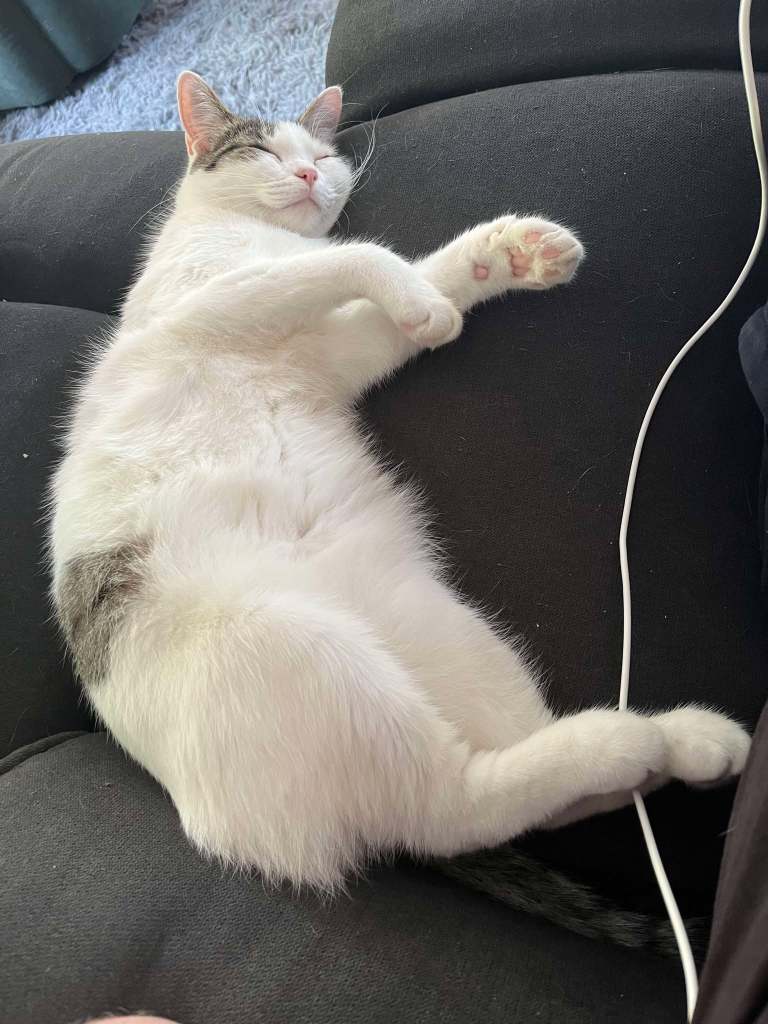
Depression: really bad. Also: solvable. I’m coming off my anti-depressants after a year and change, close to eighteen months. Some people stay on them forever. Others don’t. I don’t know what side I’ll eventually end up on. What I do know is that I am no longer depressed. I have a partner, a cat, and a future. If you’re depressed and reading this: there’s a way out.
Also, yes, here is a picture of my cat:
 bayd.ren